This is Part 2 of my series analyzing decision turnaround times at the Federal Court. See Part 1 here.
In Part 1, I explored the general distributions and trends of decision turnaround time (the number of days between hearing and decision) at the Federal Court. This article will examine practice areas at the Federal Court. I aim to analyze how of subject-matter assignment to judges affects and factors into judicial workload and efficiency.
Data from the Federal Court can be divided by subject matter. This lets us ask whether practice area correlates with decision-making time. For example, which areas are the fastest and slowest? Does the volume and proportion of immigration cases affect turnaround times? Do specialist judges write faster in their area of expertise? I examine each of these issues in the analysis below.
Data sources, acknowledgments and preface are all set out in my first post, which should be read before this one. AI was used to assist in generating data visualizations. All text (including em dashes) and errors are my own.
Editorial note (April 29, 2026): This article and the associated graphs have been edited to remove individual name labels to emphasize that the focus of the analysis is to examine observable causes of variability in decision-writing time, rather than to discuss particular judges.
Editorial note (May 14, 2026): Some of the graphs have been updated to reflect updated data processing which filled in additional information in a few cases.
Federal Court subject matter
The Federal Court is somewhat unusual. Although it is a national superior court, its jurisdiction is purely statutory rather than inherent, unlike the superior courts of the provinces.
The Federal Court derives most of its jurisdiction from the Federal Courts Act, but also hears proceedings specifically designated by federal statutes (e.g. statutes prescribing rights of appeal from federal administrative tribunals or subject-matter legislation such as intellectual property laws).
The Federal Court categorizes its own proceedings under the following headings:1
- Administrative Law
- Aboriginal Law
- Maritime and Admiralty Law
- Intellectual Property
- National Security
- Citizenship, Immigration and Refugee Law
- Class Proceedings
While not explicitly listed in the Federal Court’s description, also within its jurisdiction are Crown liability claims and certain declarations or review of discretionary decisions under the Income Tax Act (ITA), although most tax issues (appeals/reviews of tax assessments) are dealt with by the Tax Court of Canada.
For brevity (and with apologies to the citizenship/immigration/refugee bar), I generally refer to all citizenship, immigration, and refugee cases in my data and discussion below as “immigration” cases unless otherwise specified. I am aware that there are statutory, substantive, and procedural differences with respect to these subject areas although that is not the focus of the analysis.
The Federal Court’s subject areas are not distributed evenly. Immigration matters dominate the court’s docket by far, dwarfing all other areas combined. In 2025, 91% of proceedings commenced in the Federal Court related to citizenship (4.4%) and immigration (86.6%) matters.2
It is no real exaggeration to say that the Federal Court is a citizenship/immigration court that happens to hear a few other matters (Figure 1):
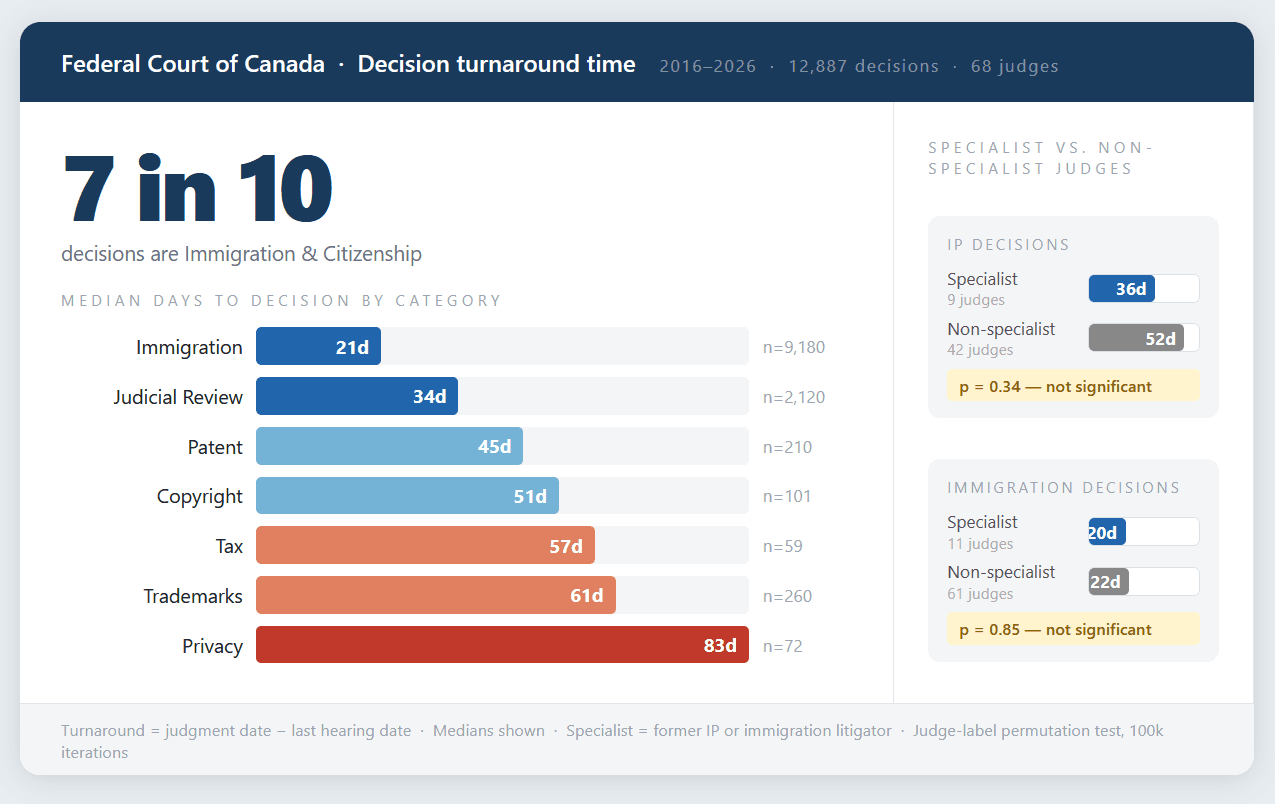
Likewise, nearly 7 in 10 (68%) reported decisions over 2016-2026 were immigration decisions (70% in 2025).
This is important context in understanding the Federal Court’s workload and case mix.
Although the Federal Court has made efforts to recruit from the immigration bar, and indeed there are many members of the bench who are specialists in the field, the immigration case load is divided among all judges.
Immigration cases make up the majority of most judges’ output, as the stacked bar chart below shows (decisions issued per judge in the last ten years). Immigration (blue) dominates all judges’ written decisions. (To make the figure easier to read I have combined admiralty, aboriginal, crown proceedings, and others into a general “Other” category, since these areas have lower relative numbers of decisions.) (Figure 2)
Notably, even the judge with the proportionally lowest immigration case load from 2016-2026 had 30% immigration cases in their issued decisions.
How does subject matter affect decision time?
Turnaround time differs across practice areas. This should be expected, and the differences are material. (Figure 3)
Immigration and citizenship cases have the fastest turnaround time by a good margin. The median reported immigration decision is issued in 21 days (mean 54d).
Interestingly, privacy decisions (which do not get as much airtime in the discussion of the Federal Court) show up as having the longest median turnaround time (83d, mean 118d). These are usually PIPEDA applications or Privacy Act requests. The longer writing time may reflect the relative novelty of many of the privacy-type actions, though it may simply be the small number of cases in comparison to other areas (privacy has the least number of reported cases in any of the Federal Court’s areas according to its own classification system).
Two observations may be of interest to the IP bar: the median trademark case takes longer than the median patent (non PMNOC) case in this dataset. Since both categories have n>200 this does not seem to be a sample size effect, which is also confirmed by their similar interquartile ranges. However, patent decisions have the highest mean decision time of all areas (120d), indicating that the mean is being significantly dragged out by the long tail of outliers. Indeed, from 2016-2026 there were 20+ patent decisions taking more than 365 days, compared to 7 for trademarks.
Put another way, turnaround times for patent and trademark matters are similar most of the time, but there are several times more “long” patent cases than trademark cases that take over a year to decide.
The “long tail” may explain some discontentment in the IP bar. Over the period studied, 2 or 3 IP decisions each year sat under reserve for more than a year—not an easy wait for clients who spent millions on cases worth tens or a hundred times more. This deserves a closer look (with final/interlocutory decisions separated) and perhaps worth a cross-jurisdictional study in the future (how quickly do other jurisdictions deal with IP actions, which presumably have a similar technical complexity?).
Turnaround time distribution across practice areas
Turnaround time distribution can also be visualized in a “violin plot” as follows. This shows how the distribution curve compares across different areas. (A violin plot essentially a series of sideways histograms: wider portions indicate more relative cases. The plot width has been normalized to compare distribution rather than absolute numbers, otherwise immigration cases would dominate the X-axis.) (Figure 4)
As seen in the violin plot, immigration cases (far left) not only have the shortest turnaround time, but they also have the “squattest” shape, indicating that it has the tightest distribution of cases concentrated at the shortest turnaround times.
Conversely, IP, non-PMNOC cases (3rd from right, purple) have a much shallower and taller ‘body’. These cases have both a higher mean time to decision and a wider spread. The unique shape at the top on the IP data (almost like a “scroll” of a violin) shows that there is not just a “long tail” of lengthy IP cases, but a “fat tail” representing a significant number of cases that take more than 300 days to decide.
While it is not quite bimodal, the shape and distribution (also shown in the histograms in Part 1) suggest that there are some “hard” cases in IP that are causing judges to keep them under reserve for longer, more so than in other subject areas.
Subject matter assignment and turnaround time
Since Federal Court judges all decide cases across multiple areas, it is reasonable to ask whether subject-matter makes a difference to their writing time.
However, subject-matter has two potentially opposing effects on turnaround time.
Since immigration decisions are generally quicker to decide, and there are more of them than any other area, you might expect that judges who deal with a higher percentage of immigration cases on their docket would have a faster average. However, when plotted across the entire court, this is not really the case. (Figure 5)
The proportion of immigration cases decided by each judge does not have any statistically significant (p < 0.05) correlation with overall turnaround time (in any event, even if it were significant, the correlation is very weak at R2 = 0.056).
I then considered the possibility that proportion of docket may not be measuring immigration workload, which could have an impact on turnaround time. So, I also looked at the number of immigration cases decided per year. There was no correlation between immigration case load (annualized number of reported cases) and overall decision writing time either. (Figure 6)
Note that in the plot above, since I was comparing immigration case load, I used the annual number of reported cases but removed the first year of data for each judge as a judge may be appointed any time during a year and/or may not have ramped up their docket. The rump year of 2026 is also excluded from these data.
This result is similar to my discussion on workload in the first part of this series. (I did this analysis before writing up the section on workload in my earlier post which would have also disproved this hypothesis).
My ex ante was expectation that higher workload slows writing time. But the reverse is also plausible: judges with heavier dockets may push to clear them faster, counteracting any correlation in the aggregate.
Though neither hypothesis proved fruitful, showing “negative data” is important to counteract publication bias.3
The plot does reveal something though – there is a cluster of judges (bottom right) who write a high number of immigration decisions and have fast turnaround times, all of whom are immigration law specialists. This verifies at least some of our intuition that immigration law specialists are adept at handling larger case loads in this area without material adverse effect on overall turnaround time.
Do specialist judges write faster?
Given the observation on immigration judges, this leads to another hypothesis: do specialist judges write faster within their specialty?
I appreciate that this sounds like a silly question, but in data science it is important to see if the data actually matches with expectation. In fact, it is a little tricky to prove (or disprove) this hypothesis.
An aside on judicial specialization
In 2023, the Federal Court formally created “Specialized Chambers” assigning judges to specific subject areas, recognizing the benefit of having a roster of judges hear particular types of matter more frequently, although this was already the informal practice of the court for many years.4 The IP bar has identified specialization as a tool in “timely and effective handling of cases” as well as a possible “improvement in the consistency of case law”.5
Presently, there are four such chambers (Intellectual Property and Competition, Maritime and Admiralty, Class Proceedings, and Aboriginal Law). Perhaps pointedly, there is no chamber for immigration matters.
The 2016-2026 dataset includes decisions both before and after the official formation of the chambers. Because the Court was already informally assigning certain judges more cases in particular areas, there was no noticeable discontinuity after 2023 for judicial assignments.
Judges are assigned to hearings partly based on availability in addition to specialty. Judges’ dockets for trials are often booked about 12-18 months in advance. However, when matters settle shortly before a hearing, it is not always possible to re-assign judges to multi-day trials of comparable length within the same subject matter (particularly on short notice).
In many cases, such judges are assigned to the ongoing queue and backlog of immigration matters. This has been a known source of frustration among some judges and the judicial administrator.
This method of case assignment results in scenarios where IP specialist judges hear a significant amount of other (mostly immigration) cases. Many “IP judges” have dockets consisting of between 60-75% immigration cases.
Because of this, the mere existence of the specialized chambers project does not necessarily assist as a data point for analysis.
How do judges compare across subject areas?
As a first cut at the question, and to look for potential patterns, we can visualize how judges perform across practice areas using a heatmap. This is a little information-dense but may reveal certain patterns.
In this heatmap, sorted from slowest to fastest overall (top to bottom), I have plotted a judge’s normalized turnaround time (deviation from median). Red represents longer than median in that area, blue represents less than median, while white is median. Each column is a different subject area. I have included only the three most prevalent subject areas: immigration, judicial review (administrative law), and IP, along with “other” capturing the rest. (Figure 7)
The heatmap reveals some interesting features about subject-matter that was not readily apparent before.
Certain judges have very distinct patterns depending on subject matter, indicating a longer turnaround time in certain areas. However, this heat map is a mixed bag of evidence only weakly suggesting that IP decisions may take longer for non-specialists.
Conversely, there appear to be judges who issue decisions in IP faster (on a relative basis) than in immigration. However, some of this is likely due to small sample size (judges with n<=5).
Another dimension that may be relevant is complexity, which will come in a future post. For now, these data points are interesting points of reference.
Do “IP judges” write IP decisions faster?
One possible benefit of appointing specialist judges was to avoid the need to “teach the judge the law”. Presumably, specialist judges have a baseline knowledge of their area of law that reduces reading and writing time. This should theoretically be positive for decision turnaround time.
However, the data does not bear this out in any significant way.
Since the “chambers” are relatively new (2023) and broad (for example the IP group is actually “IP and Competition”), the Court’s chambers classification was not particularly useful to answer our question.
Instead, to isolate for IP expertise, I manually tagged “IP specialists” based on their practice area before being appointed (admittedly, this is subjective although I think the distinction is relatively clear among the IP bar.)
Overall, the “IP Specialists” had a modest edge over “Non-Specialists” in decision time (median 40d vs 58d; mean 89d vs 111d). Both sets of judges had a similar distribution (left graph). (Figure 8)
However, this difference was not statistically significant at a per-judge level. Because there are only 9 specialist judges tagged in the data, individual variation significantly impacts the analysis. More particularly, since one judge issued 64 IP decisions in this period (almost double the next closest judge and accounting for more than a quarter of all “specialist” decisions), those decisions significantly pulled down the averages. If this judge was omitted from the data, the “IP Specialist” group would actually have a longer turnaround time (median 69d, mean 116d) than the “Non-Specialist” group on IP cases.
As more clearly seen on the righthand graph above, there is no obvious trend in per-judge rankings based solely on specialty in IP practice. There are some IP judges who are fast and some who are slow. There was no statistical significance in these data (p = 0.34, permutation test). In other words, if you tagged any 9 judges as “specialists” and assigned them randomly across the reported cases, you would expect to see the same type of result at least a third of the time.
Therefore, based on our data, we cannot conclude that “IP judges” write IP decisions decidedly faster than generalist judges, although further data may be necessary over time.
Do “immigration judges” write immigration decisions faster?
Because of the significantly larger sample size for immigration decisions, I thought that if there would be any effect of specialist judges, it would show up there. Like above, I manually tagged judges as “immigration specialists” based on substantial pre-bench practice in immigration law as derived from public sources. Since I am not an immigration law expert I admit that my assumption could be wrong here and would be happy to be corrected. (Figure 9)
The difference in median decision time was minimal (20d vs 22d). There was no detectable statistical difference on a per-judge basis.
Decision-making time is more variable among non-specialists than specialists, as shown in the box plot on the left (wider interquartile range). The mean turnaround time for specialists was 43d, compared to non-specialists 58d, confirming the greater difference in variability.
Non-specialist judges (see top of right-hand graph) seem to have a greater tendency to take longer to issue immigration decisions, but there are also a large group of non-specialists who issue immigration decisions quickly (bottom-most dots in red), so it is far from establishing a trend.
Additionally, even with the outliers, the specialist judges (blue diamonds) are fairly evenly dispersed within the overall data (right chart). On a per-judge basis there is no statistically detectable difference in the median turnaround times (p = 0.85, permutation test).
Given our sample size (n=8692 after omitting judges with n<20 decisions, 62 qualifying judges), we can have good confidence in this data. Immigration judges do not issue immigration decisions materially faster in immigration cases. Some non-specialist judges take longer in this area but the reason is unclear from the data and is not statistically significant.
Conclusions
Subject matter “matters” in that some types of cases are inherently faster to decide than others. Across the data, immigration cases are the fastest. But their overall effect on turnaround times comes mostly from their sheer volume.
When looking across judges, there do not appear to be any meaningful correlations between their immigration docket (either measured as case mix or workload) and overall decision-making time. In other words, judges who hear more (or fewer) immigration cases are not statistically faster (or slower).
Certain judges show tendencies toward faster/slower decisions in certain areas compared to the rest of the Court, but this is not a pronounced effect and only apparent for a small number of judges.
Specialist judges do not appear to write faster decisions in their areas of expertise, once corrected for individual judge effects. Marginal differences in median decision time of specialist judges appear to be driven by individually prolific judges rather than by subject matter per se.
The data suggests that other inter-judge factors are far more influential on turnaround time than subject matter.
What’s next?
I have been gathering data in response to several inquiries from members of the bar relating to decision complexity and hearing times. The next post will likely look at the effect of complexity across various measures, and I will try to disentangle whether those factors are better determinants of decision time than subject matter.
Update: Part 3 (complexity) has been published.
Footnotes
- https://www.fct-cf.ca/en/pages//about-the-court/jurisdiction ↩︎
- https://www.fct-cf.ca/en/pages//about-the-court/reports-and-statistics/statistics-december-31-2025#cont ↩︎
- See e.g. Joober et al (2012), Publication bias: What are the challenges and can they be overcome?. Journal of Psychiatry and Neuroscience. 37(3): 149-152. https://doi.org/10.1503/jpn.120065; Nair, “Publication bias – Importance of studies with negative results!”, PMID: 31263309 ↩︎
- Federal Court, Notice to the Parties and the Profession – Pilot Project: Chambers of the Court ↩︎
- A Shaughnessy (2023), Specialist or Generalist Judges in IP: Is the Jury Still Out? | Ontario Bar Association ↩︎
Leave a Reply